
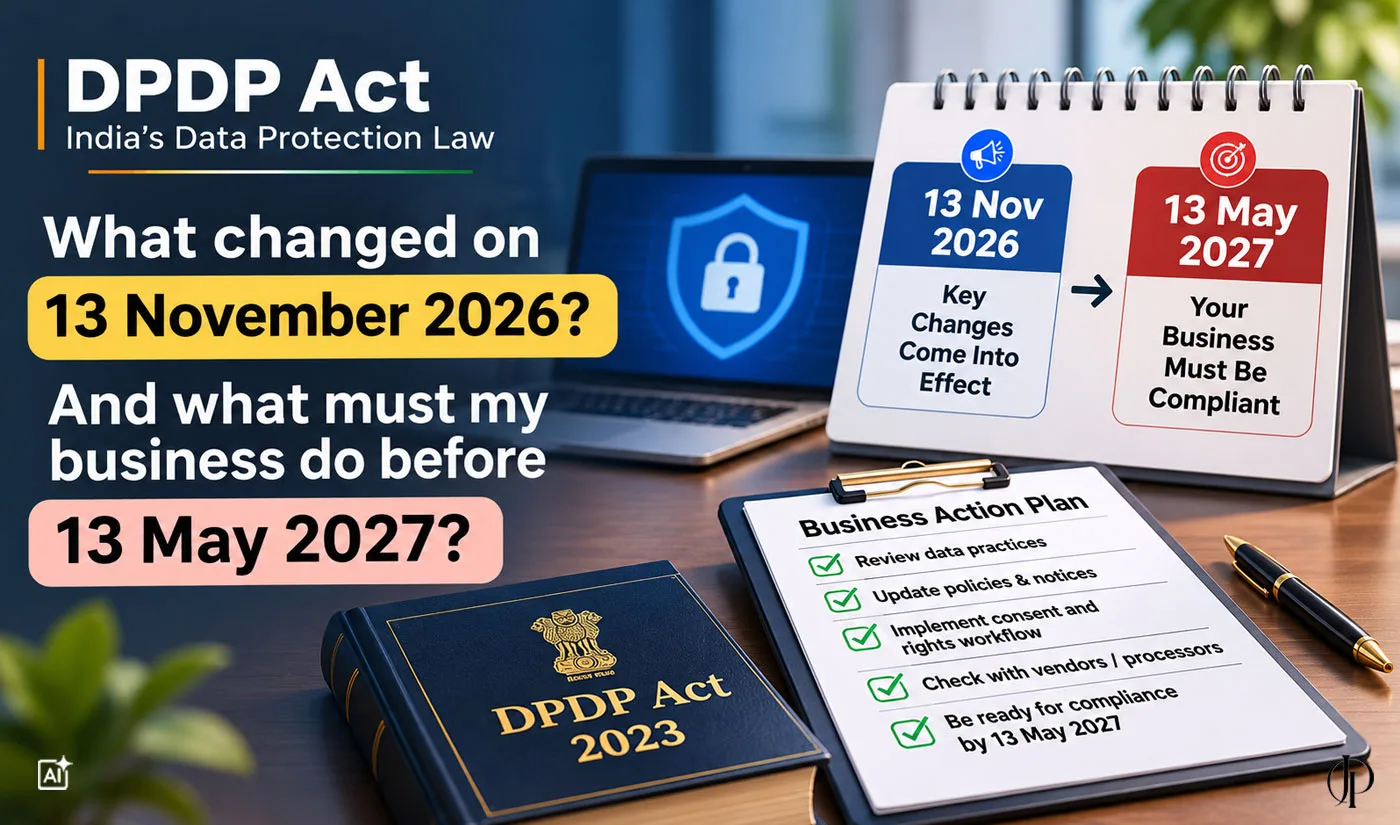
The second phase of India’s data protection law began on 13 November 2026. This phase only affects Consent Managers, so most businesses did not need to take any action on that date. The key date for most businesses is 13 May 2027, when the main requirements—such as clear notice, valid consent, security measures, breach reporting, and user rights—come into effect. The important thing now is to focus on what needs to be done in the remaining months.
Let’s start by defining three key terms.
A Data Fiduciary is a business that decides why and how personal data is used. If you run a clinic, an online store, or a SaaS company, you are considered a Data Fiduciary.
A Data Principal is the individual whose data is being collected. This could be your patient, customer, or user.
A Consent Manager is a company registered with the Data Protection Board of India. It provides individuals with a single platform to give, manage, review, and withdraw their consent.
What changed on November 13, 2026
Three new rules started to apply:
Section 6(9) of the DPDP Act, 2023. Every Consent Manager must be registered with the Board.
Section 27(1)(d) of the Act. The Board can inquire into a breach of a registration condition and impose a penalty.
Rule 4 of the DPDP Rules, 2025, read with the First Schedule. These set the conditions and duties of a Consent Manager.
Only companies registered in India can apply. They must also have a net worth of at least two crore rupees.
Will this affect most businesses?
Not right now. Businesses do not have to become Consent Managers at this stage.
The next step is on the way. Starting May 13, 2027, section 6(7) of the Act will allow people to give, manage, review, or withdraw consent through a Consent Manager. After that date, you might receive a consent withdrawal through a Consent Manager, so your systems should be ready to handle it.
What starts on 13 May 2027
Rules 3, 5 to 16, 22, and 23 will take effect, along with the rest of the main parts of the Act. Businesses should make sure they are prepared for these changes.
Notice (section 5, Rule 3). Before asking for consent, explain in clear and simple language what data you collect and why. Provide a detailed list of the data. The notice should be easy to understand by itself, without needing to read anything else.
Consent (section 6). Consent must be freely given, specific, informed, unconditional, and clear, and shown through a clear action. Withdrawing consent should be just as easy as giving it. If there is ever a question in a legal process, the business must show it gave notice and got consent.
Security safeguards (section 8(5), Rule 6). You need to take reasonable steps to prevent data breaches. Rule 6 lists minimum measures, such as encryption or masking, access controls, logging and monitoring, and backups. Keep relevant processing, access, and traffic logs for at least one year for security and breach reasons. Any contract with a vendor handling the data must require these same safeguards.
Breach reporting (section 8(6), Rule 7). If there is a personal data breach, notify each affected person and the Board immediately. Then, provide the Board with all required details within 72 hours of learning about the breach. The Board can allow more time if the Rules permit.
Retention and erasure (section 8(7), Rule 8). Delete personal data when consent is withdrawn, or you no longer need it, unless the law requires you to keep it. This does not mean you should keep all personal data for a year. The one-year rule only applies to relevant processing, access, and traffic logs, not to all personal data.
User rights (sections 11 to 14, Rule 14). People can ask for a summary of their data, request corrections, or ask for their data to be erased. They can also raise a complaint or choose someone to act on their behalf. You need to publish instructions on how to make a request. You must respond to complaints within your published time frame, but never later than 90 days.
Children’s data (section 9, Rule 10). Anyone under 18 is considered a child. Before handling a child’s data, you must get verifiable consent from a parent. Rule 12 and the Fourth Schedule allow limited, purpose-specific exemptions for certain groups, such as healthcare providers and schools, but only when needed for essential reasons like healthcare, education, or real-time safety. These are not general exemptions from the children’s data rules.
An example
Imagine an online store in Gurugram that sells home goods to adults. The store keeps names, phone numbers, addresses, and order history. It works with a cloud host, a courier, and a messaging service.
By 13 May 2027, the store must show a clear notice at checkout listing what data it collects and why. It should offer a way to withdraw consent that is as simple as the tick box used to give it. The store also needs contracts with all three vendors that include security rules. There should be a public way for customers to send requests or complaints. Finally, the store needs a written plan for what to do in the first 72 hours after a data breach.
Each of these steps is simple on its own. They only become difficult if you wait until the last month to do them.
Steps to take before the deadline
Make a list of the personal data you have, where it is stored, and who has access to it.
Note the reason you collect each type of data. If you do not need certain data, stop collecting it.
Update your notices and consent screens so they are easy to understand.
Go through each Rule 6 safeguard, including the rule about keeping logs for one year.
Look over your vendor contracts to make sure they include security requirements.
Create a breach response plan that lists names and phone numbers and explains the 72-hour reporting deadline.
Set up a single way for users to make requests and keep track of the 90-day response limit.
Possible risks if you do not comply
Under section 33, the Board can impose a monetary penalty if it finds that a breach of the law is significant. The Schedule to the Act sets the limits. Failure to take reasonable security safeguards can attract a penalty of up to 250 crore rupees. Failure to give notice of a breach can attract a penalty of up to 200 crore rupees. The Board must consider factors such as the gravity of the breach and the steps taken to reduce harm.
Summary
13 November 2026 was only for Consent Managers. For everyone else, the key date is 13 May 2027. The duties and Rules are already published. If your business maps its data, updates its notices, checks security, and prepares for a breach now, you will be ready by May without last-minute stress.