
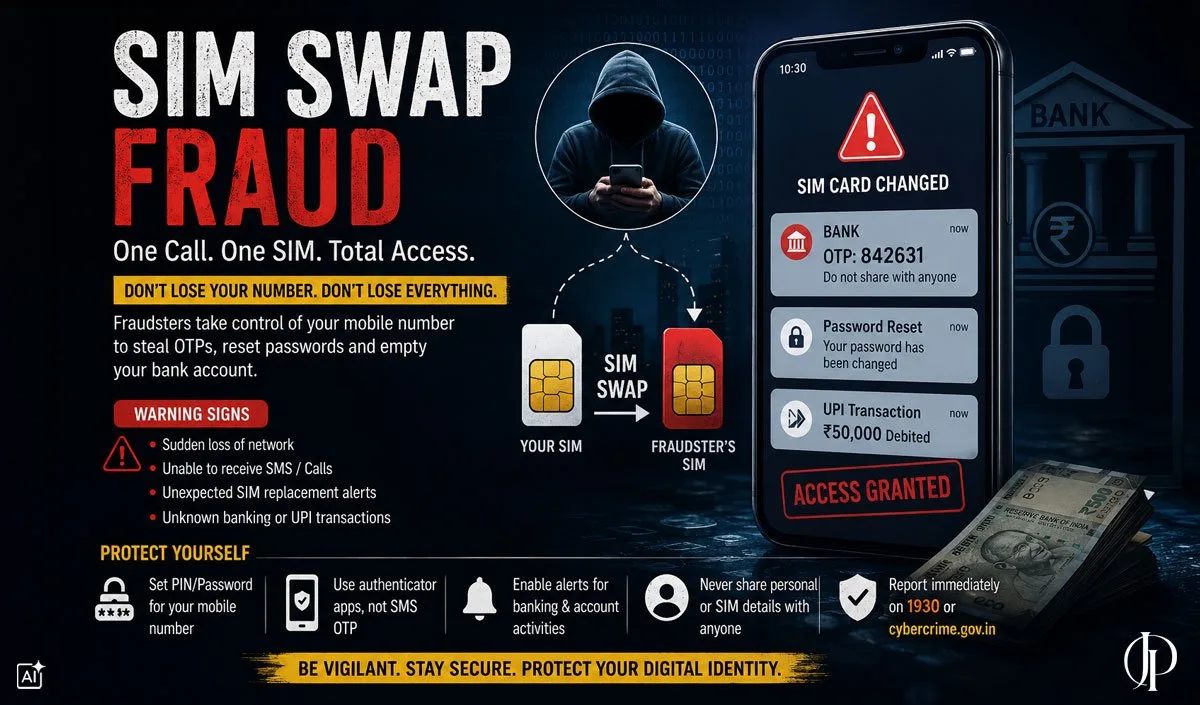
Imagine waking up one morning to find your mobile network has stopped working. No calls. No SMS. No internet. At first, it may seem like a temporary telecom issue.
A few hours later, you discover money missing from your bank account, your UPI apps inaccessible, and passwords for important online accounts changed.
This is not a hypothetical situation. It is exactly how many victims discover they have been targeted by SIM swap fraud.
As India embraces digital banking, UPI payments, online investments, and mobile-based authentication, SIM swap fraud has become one of the most dangerous cybercrimes. Unlike traditional hacking, fraudsters do not need to break into your device. They take control of your mobile number.
Once they control your number, they can intercept OTPs, reset passwords, bypass security checks, and gain access to financial and personal accounts within minutes.
What Is SIM Swap Fraud?
SIM swap fraud, also known as SIM hijacking or SIM cloning fraud, occurs when a fraudster convinces a telecom operator to transfer a victim's mobile number to a new SIM card under the fraudster's control.
After the swap is completed, all calls, SMS messages, OTPs, and account verification requests intended for the victim are redirected to the criminal.
Because many banks, payment applications, and online services still rely heavily on SMS-based authentication, gaining control of a mobile number often gives criminals access to a person's entire digital identity.
In simple terms, the fraudster does not steal your phone. They steal your phone number.
Why SIM Swap Fraud Is Growing in India
India's digital ecosystem is heavily dependent on mobile numbers.
Your mobile number is linked to:
Bank accounts
UPI applications
Credit cards
Trading accounts
Email accounts
Aadhaar-linked services
Social media profiles
Corporate communication systems
As a result, a single compromised number can provide access to multiple accounts.
Recent cybercrime reports and court cases across India highlight losses from a few lakhs to over one crore rupees. The financial damage is significant, but reputational and emotional consequences can be equally devastating.
For business owners, startup founders, and corporate executives, a SIM swap attack can expose confidential information, disrupt operations, and trigger compliance concerns.
How SIM Swap Fraud Usually Happens
Most SIM swap attacks start long before the fraudster contacts the telecom provider.
Step 1: Gathering Personal Information
The criminal collects information about the victim through:
Phishing emails
Fake customer support calls
Data breaches
Social media profiles
Fraudulent KYC requests
Malware or spyware attacks
Even harmless information like date of birth, address, Aadhaar details, or banking relationships can be useful.
Step 2: Social Engineering
The fraudster impersonates the victim and contacts the telecom provider claiming that:
The SIM card is damaged
The phone has been lost
A replacement SIM is required
The number needs to be ported
If verification procedures are weak or compromised, the telecom provider may issue a replacement SIM.
Step 3: Number Takeover
Once the new SIM is activated, the victim's original SIM immediately loses service.
At this point, the fraudster begins receiving all OTPs and verification messages.
Step 4: Financial Theft
The criminal then:
Resets banking passwords
Accesses UPI applications
Changes account credentials
Transfers money
Gains access to email accounts
Takes control of digital wallets
Many victims only realise something is wrong after discovering unauthorised transactions. Could Never Ignore
SIM swap fraud often provides early warning signals.
Pay immediate attention if you notice:
Sudden loss of mobile network
Inability to make or receive calls
SMS messages are stopping unexpectedly
Notifications regarding SIM replacement
Unexpected telecom account updates
Banking alerts for transactions you did not initiate
Password reset requests you did not make
Many victims ignore these warning signs for hours, giving fraudsters enough time to empty accounts.
Why This Is Also a Cyber Law Issue
SIM swap fraud is not merely a banking problem.
It involves multiple legal dimensions, including:
Identity theft
Cheating by personation
Unauthorised access to computer resources
Data misuse
Financial fraud
Negligence in verification processes
Depending on the circumstances, offences may attract provisions under:
The Information Technology Act, 2000
Bharatiya Nyaya Sanhita (BNS)
Banking and payment regulations
RBI customer protection frameworks
Legal responsibility may extend beyond the fraudster if weaknesses in verification processes contributed to the incident.
The Biggest Security Mistake: Relying Only on SMS OTPs
For years, SMS OTPs have been treated as a secure authentication method.
Today, cybersecurity professionals increasingly view SMS authentication as a weak security layer.
The reason is simple.
If an attacker controls your mobile number, they effectively control your OTPs.
Businesses and individuals should move toward stronger alternatives such as:
Authenticator applications
Passkeys
Hardware security keys
Multi-factor authentication systems
Risk-based authentication solutions
The future of digital security cannot rely solely on a mobile number.
Practical Safety Tips to Protect Yourself
Reducing SIM swap fraud risk requires a combination of awareness and security controls.
Secure Your Telecom Account
Ask your telecom provider whether they offer:
Account PIN protection
SIM replacement passwords
Additional identity verification controls
Protect Personal Information
Never share:
Aadhaar details
PAN information
OTPs
Banking credentials
SIM-related information
With unknown callers or suspicious websites.
Use Strong Authentication
Wherever available:
Enable authenticator apps
Use passkeys
Turn on multi-factor authentication
Avoid SMS-only verification
Monitor Financial Activity
Enable alerts for:
Bank transactions
UPI payments
Credit card usage
Login attempts
Regular monitoring helps detect fraud early.
Secure Your Email Account
Your email account often acts as the master key for password recovery.
Use:
Strong passwords
Multi-factor authentication
Security alerts
to protect it.
What To Do If You Suspect a SIM Swap Attack
Time is critical.
The faster you act, the better your chances of limiting losses.
Step 1: Contact Your Telecom Provider Immediately
Use another phone and report:
Loss of network
Unauthorised SIM replacement
Suspected number takeover
Request immediate suspension or blocking of the compromised SIM.
Step 2: Inform Your Bank
Contact your bank and request:
Temporary account freeze
UPI suspension
Blocking of suspicious transactions
Step 3: Change Passwords
Update passwords for:
Email accounts
Banking applications
UPI services
Investment platforms
Using a secure device.
Step 4: Report The Incident
File a complaint through:
Cyber Crime Helpline: 1930
National Cyber Crime Reporting Portal
Preserve screenshots, messages, transaction records, and telecom communications.
Step 5: Maintain Evidence
Keep records of:
Complaint numbers
Emails
Telecom responses
Bank communications
Transaction details
These may be important for recovery and legal proceedings.
The Corporate Compliance Perspective
Businesses often underestimate SIM swap risks.
Many organisations still rely on mobile OTPs for:
Financial approvals
Customer verification
Employee authentication
Vendor onboarding
Administrative access
This creates significant risk.
Companies should:
Conduct fraud risk assessments
Strengthen identity verification processes
Reduce dependence on SMS authentication
Train employees on social engineering attacks
Implement incident response procedures
Review telecom-related security controls
Cybersecurity is no longer just an IT issue. It is a governance, compliance, and business-continuity issue.
SIM swap fraud demonstrates how fragile digital trust can be.
A single compromised mobile number can unlock bank accounts, email accounts, investment portfolios, business systems, and personal information within minutes.
For individuals, vigilance and stronger authentication methods are essential.
For businesses, the lesson is even more important: identity verification cannot rely on a single OTP sent to a mobile phone.
As cybercriminals become more sophisticated, organisations and individuals must move beyond outdated security practices and adopt layered protection mechanisms that can withstand modern fraud techniques.
Because in today's digital world, protecting your mobile number is often the same as protecting your identity.