
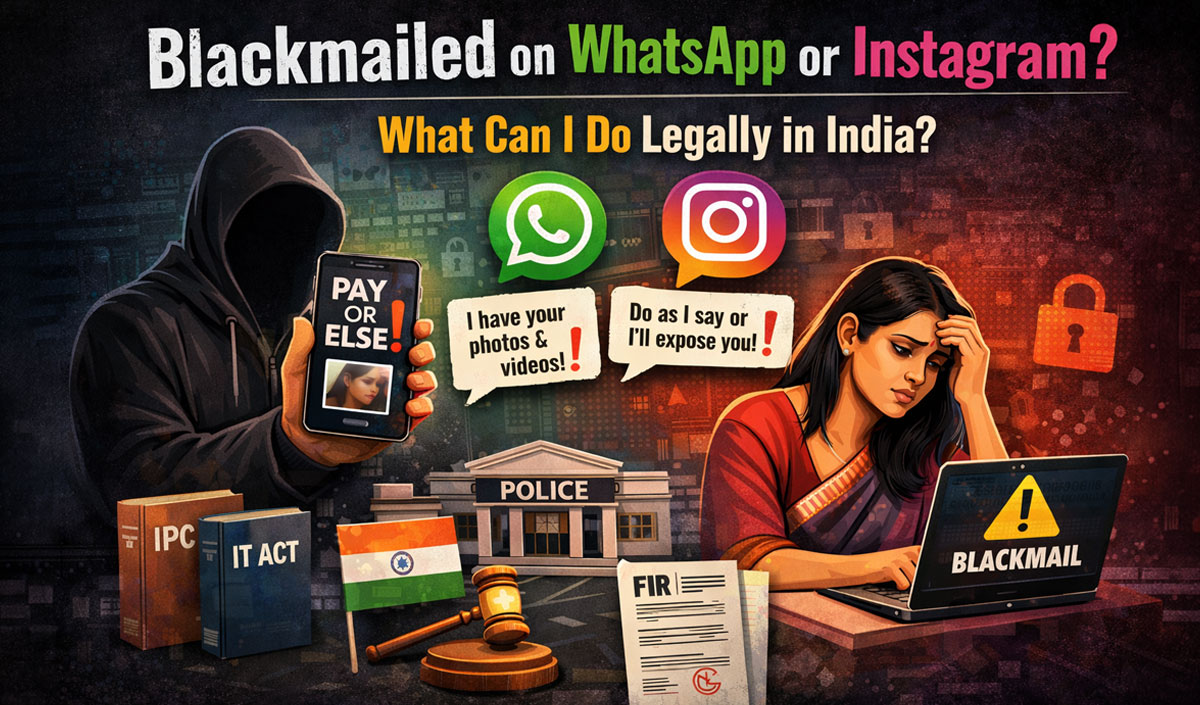
You got a message last night. Someone says they have your photos, or at least claims to. They are demanding money. If you refuse, they threaten to send those photos to your family, your employer, or your contacts.
Your hands are shaking as you search for answers in the middle of the night.
First, remember that you are not alone. Thousands of Indians face this every month. More importantly, Indian law supports you. You have real legal options. This guide will explain them all clearly, step by step, without legal jargon.
What Is Actually Happening to You (And Why You’re Being Targeted)
This crime is called sextortion or cyber blackmail. It usually follows a predictable pattern.
The blackmailer might reach out to you on Instagram, Facebook, a dating app, or WhatsApp. They act friendly, and sometimes flirt. After a few days or weeks, they convince you to share a photo or secretly record a private video call. Sometimes they use fake or AI-generated images.
After that, their true intentions appear. They start making threats and demanding money.
These attacks are not random. Many are run by organised criminal networks, and some operate from outside India. They often run many scams at the same time. In June 2025, Delhi Police broke up a sextortion racket with a money trail of over ₹1 crore. In another 2025 case, four people were arrested in Delhi’s Shahdara for running a coordinated sextortion scheme that targeted people across the city.
You were targeted. You are the victim. The law treats you as exactly that.
The First Thing You Should Do and the One Thing You Should Never Do
Never pay. Not even once.
This is the most important advice in this article: do not pay the blackmailer.
You might think paying will make the problem go away, but it will not. Each payment tells the blackmailer that you are afraid and willing to pay again, so the threats will continue. The demands usually get worse. In India, there are documented cases where victims paid five, six, or even seven times, and the blackmailer kept coming back for more.
Paying can also make your legal situation more difficult later, as it may be seen as an acceptance of the situation.
What You Should Do Right Now
Before you do anything else, save every piece of evidence:
- Screenshot every message, threat, and conversation
- Save all the profile links, usernames, and phone numbers
- Save any photos or videos they sent you as evidence, even if they are upsetting.
- Record the date and time of every communication
- Write down which platform was used, such as WhatsApp, Instagram, Telegram, or others.
- Do NOT delete any chats, even if they are disturbing
This evidence is the foundation of your legal case. Without it, everything is harder.
What Indian Law Says: The Exact Legal Provisions
Most people don’t know this, but there is no single law in India called “blackmail.” The word is informal. However, the actions involved in blackmail, such as threats, extortion, privacy violations, and sharing private content, are all serious crimes covered by different laws. Together, these laws offer you strong legal protection.
Under the Bharatiya Nyaya Sanhita (BNS), 2023
The BNS replaced the Indian Penal Code from July 1, 2024. These are the current provisions:
| BNS Section | What It Covers | Punishment |
|---|---|---|
| Section 351 | Criminal intimidation: threatening someone to cause fear or force action | up to 2 years, or fine, or both (with a higher range if the threat is anonymous) |
| Section 308 | Extortion: threatening someone to force the delivery of money or property | up to 7 years, or fine, or both; in aggravated cases (e.g., threats of death or grievous hurt), up to 10 years, or fine, or both |
| Section 318 | Cheating: deceiving someone for personal gain, causing harm | Up to 7 years for aggravated cheating |
| Section 111 | Organised crime: applies when blackmail is run by a criminal network | Rigorous imprisonment, up to life in serious cases |
| Section 71 | Voyeurism: capturing or sharing private images without consent | Up to 3 years first offence; up to 7 years on repeat |
Under the Information Technology Act, 2000
The IT Act adds specific digital protections on top of the BNS:
| IT Act Section | What It Covers | Punishment |
|---|---|---|
| Section 66C | Identity theft: misusing passwords, accounts, or any other unique identification feature of another person online | Up to 3 years, or fine up to ₹1 lakh, or both |
| Section 66D | Cheating by personation: using a computer resource or communication device to deceive by pretending to be another person | Up to 3 years, or fine up to ₹1 lakh, or both |
| Section 66E | Violation of privacy: capturing, publishing, or transmitting images showing private areas of a person without consent, when done to violate their privacy | Up to 3 years, or fine up to ₹2 lakh, or both |
| Section 67 | Publishing or transmitting obscene material in electronic form | Up to 5 years, or fine up to ₹10 lakh, or both on first conviction; on second or subsequent conviction, up to 7 years, or fine up to ₹10 lakh, or both |
| Section 67A | Publishing or transmitting material containing a sexually explicit act, etc., in electronic form | Up to 7 years, or fine up to ₹10 lakh, or both on first conviction; on second or subsequent conviction, up to 7 years, or fine up to ₹10 lakh, or both (with higher exposure in aggravated forms under 67B and related provisions) |
If the Victim Is a Minor
If you are under 18, or if the victim is a minor, the POCSO Act, 2012 also applies. This law brings much stricter punishments, and the investigation is treated as a priority.
The Key Takeaway on Law
A blackmailer is not just breaking one law. They are probably breaking several at once. Each threat, demand, or private image shared without consent counts as a separate crime with its own punishment. The law is strongly against them.
Step-by-Step: How to Take Legal Action
Step 1: Report on the National Cyber Crime Portal (Do This Today)
The National Cyber Crime Reporting Portal (cybercrime.gov.in) is the Government of India’s official platform for reporting cyber crimes, managed by the Indian Cyber Crime Coordination Centre (I4C) under the Ministry of Home Affairs.
Here is exactly how to use it:
- Go to www.cybercrime.gov.in
- Click “Report Women / Children Related Crime” if you are a woman or the victim is a minor. You can report anonymously here. For all other cases, click “Report Other Cyber Crime.“
- Register with your mobile number and email
- Fill in the complaint form: be specific: dates, platform names, usernames, phone numbers, what was threatened, whether money was demanded
- Upload your screenshots and evidence
- Submit and save your complaint reference number. You will need this for follow-up
You can also call the dedicated Cyber Crime Helpline at 1930 on working days between 9 AM and 6 PM for guidance on filing your complaint.
Step 2: File an FIR at the Cyber Police Station or Local Police Station
Filing an online complaint is important. However, if you are dealing with serious cases such as threats involving sexual content, ongoing extortion, or organised networks, you should also file a physical FIR.
Go to your nearest police station or dedicated Cyber Police Station with:
- Printed copy of your online complaint and reference number
- Printed screenshots of all threats and conversations
- Your ID proof
- A written account of what happened, in chronological order
If the local police are reluctant to register the FIR, which does happen, you have two options:
- Approach the Superintendent of Police (SP) of your district with a written complaint
- File a complaint before the concerned Magistrate under Section 173 of the Bharatiya Nagarik Suraksha Sanhita (BNSS), 2023. The Magistrate can then direct the police to register the FIR
Do not leave the police station without getting an FIR number. The FIR number is your proof that the matter is officially under investigation.
Step 3: Report to the Platform Directly
As you move forward with legal action, also report the blackmailer’s account to the platform they are using.
On Instagram: Go to their profile → tap the three dots → Report → “It’s inappropriate” → follow the prompts for harassment or blackmail
On WhatsApp: Open the chat → tap the contact name → scroll to “Report” → report and block
This is important because platforms can suspend accounts, retain metadata, and cooperate with law enforcement. According to Rule 3(2)(b) of the IT Rules, 2021, Indian courts can order platforms to remove content and share user data. These powers have already helped in several cases involving cyber blackmail and non-consensual content.
Step 4: If You Are a Woman, Contact the NCW
The National Commission for Women (NCW) offers an online complaints portal at ncwapps.nic.in for women who are facing cyber harassment or blackmail.
The NCW can:
- Intervene directly with the police and platforms
- Escalate the matter when progress is slow
- Provide support (mediation, counselling, or monitoring of investigation) that is sometimes faster than the plain complaint route
You can file through the portal or also send a written complaint by post/hand with supporting documents.
Step 5: Talk to a Lawyer, Especially If the Blackmailer Won’t Stop
If the blackmailer keeps going after you complain, or has already shared explicit content, it’s time to get a lawyer involved. A lawyer can help you in several ways:
- Draft an urgent application to the court for a takedown order under the IT Act
- Apply for an injunction to prevent further sharing of content
- Assist in building a stronger FIR with the correct framing of offences (e.g., criminal intimidation, extortion, voyeurism, publishing obscene or sexually explicit material)
- Advise on recovery of money already paid, if applicable
Acting quickly is important in these situations. The sooner the content is removed, the less damage it can do, and the better your chances of keeping strong evidence before it gets deleted by you or the platform.
What About the Content That Has Already Been Shared?
This is a question that often worries people, and it deserves a clear answer.
If content has already been shared, there are still ways to address it. Here are some legal steps you can take:
- A court can issue a takedown order directing the platform to remove the content; this is usually done under powers given to courts and the government under Section 69A of the IT Act.
- You can report the content directly to the platform using their Community Standards or safety reporting process. Most platforms remove non-consensual intimate content quickly once it is reported, especially if their policies clearly ban this type of material.
- The IT Act’s provisions on publishing obscene and sexually explicit content (Sections 67 and 67A) apply to whoever shared it. The blackmailer is now committing an additional offence with every share, and each new upload can be treated as a fresh offence.
- You can notify CERT-IN (Indian Computer Emergency Response Team) about serious cyber-related incidents at incident@cert-in.org.in. They can help coordinate technical and incident response actions, but criminal enforcement is still handled by the police and courts.
The sharing of private images without consent (especially of private areas) is itself a crime under Section 66E (violation of privacy) and, if the content is obscene or sexually explicit, also under Sections 67 / 67A of the IT Act. Each instance of sharing (a new upload, repost, or forward) adds to the blackmailer’s criminal liability and can support separate charges.
Real Examples From India: You Are Not Alone
Case 1: Delhi-style blackmail targeting a businessman
Between 2022 and 2024, several cases in Delhi involved businessmen being lured through social media, meeting someone at a hotel, being recorded in a compromising situation, and then blackmailed for large amounts of money. These sums often reached several lakhs, sometimes as much as ₹20 lakh. In one case, police registered an FIR under Sections 351 (criminal intimidation), 308 (extortion), and 318 (cheating) of the Bharatiya Nyaya Sanhita (BNS), leading to the accused’s arrest and prosecution.
Case 2: Hyderabad-style blackmail involving a minor
In Hyderabad and other cities, there have been several cases where a minor, often about 17 years old, is befriended online, persuaded to share intimate images, and then blackmailed for money with threats to distribute those images. In one case, a 19-year-old student reported a man who used an AI-generated nude image to blackmail her. Police registered the case under relevant sections of the IT Act, including Section 67A for sexually explicit material, as well as BNS provisions for blackmail and harassment.
Case 3: Delhi, 2025 sextortion racket with an organised crime angle
In mid‑2025, Delhi Police busted a multi‑state sextortion and cyber‑fraud racket in which victims were lured through social media and loan‑scam‑type lures, then blackmailed using recording‑based or morphed‑content threats. The money trail exceeded ₹5 crore, and the operation showed strong hallmarks of an organised‑crime network (multiple handlers, fake call‑centre‑style structure, and reuse of tools and accounts). Such operations are now often treated as organised‑crime‑type activities, and courts and police are increasingly using Section 111 BNS (organised crime) alongside individual extortion and IT‑Act charges in similar cases.
Why this is important
These scenarios were resolved because the victims formally reported the incidents (via the National Cyber Crime Reporting Portal and local cyber/regular police stations). Investigations show that many blackmailers rely on traceable phone numbers, UPI/payment trails, and identifiable social‑media usernames, and cybercrime cells in major cities like Delhi and Hyderabad have become significantly more effective at tracking such networks in 2023–2025.
Note for readers: While the stories above are simplified and slightly generalised, they reflect real‑world patterns observed across India in recent years. The locations, victim profiles, amounts, and sections cited are indicative of how such cases are actually investigated, rather than extracts from a single, named case‑law or press release.
Quick Reference: What to Do Right Now
If you are reading this because this is happening to you right now, here is the summary:
Do not pay. Do not delete evidence. Do not panic.
| Action | How | When |
|---|---|---|
| Preserve all screenshots and evidence | Screenshot everything, save profile links | Right now, before anything else |
| Report online | www.cybercrime.gov.in | Today |
| Report on the platform | 1930 (9 AM – 6 PM, working days) | Today |
| File FIR | Nearest police station or Cyber Police Station | Within 24–48 hours |
| ncwapps. nic.in | Instagram / WhatsApp report function | Today |
| Contact NCW (women) | ncwapps.nic.in | Today if applicable |
| Consult a lawyer | If threats continue or content is shared | As soon as possible |
The blackmailer is threatening to send my photos to my family. Can a court stop them?
Yes. A court can issue an injunction or interim order directing the blackmailer to refrain from sharing content, and can additionally order platforms to remove any content already shared. Under Section 108(1)(i)(a) of the BNSS, 2023, you can also approach a Magistrate proactively, before the content is shared, if you have a credible reason to believe the blackmailer will act. Acting before the damage is done is significantly more effective than trying to undo it after.
I already paid the blackmailer. Have I done something illegal?
No. Paying under threat of harm does not make you legally guilty of anything. It may, however, complicate your case slightly; the blackmailer might argue you consented to a payment arrangement. This is why legal advice at the earliest stage matters. Payment records and transaction history can also serve as evidence of extortion; they show that you paid under threat, which is exactly what the law on extortion addresses.
The blackmailer is from another state or possibly outside India. Can I still file a case?
Yes. Under the IT Act, cybercrime cases have nationwide jurisdiction; you can file a complaint at any Cyber Crime Cell in India, regardless of where the offender is located. For offenders based outside India, the IT Act and BNS provide for the prosecution of crimes committed against Indian individuals, even if committed abroad. International cooperation in cybercrime cases has also improved significantly, particularly for cases involving financial fraud and sextortion networks.
The police are not taking my complaint seriously. What can I do?
First, try filing your complaint at the dedicated Cyber Police Station rather than a general police station. Cyber Cells are better equipped and more experienced with these cases. If the police refuse to register an FIR without adequate reason, you can: (1) send a written complaint to the Superintendent of Police of your district, or (2) file an application before the competent Magistrate under Section 173 of the BNSS, 2023, requesting the Magistrate to direct the police to register the FIR. Courts have consistently held that police cannot refuse to register an FIR in cognisable offences.
The photos they have are fake or morphed. Does that matter legally?
No, the use of morphed, AI-generated, or fake intimate images for blackmail is equally illegal under Indian law. The offence of criminal intimidation (Section 351 BNS) and extortion (Section 308 BNS) apply regardless of whether the threatening content is real or fabricated. The threat itself, and the intention to cause fear and extract money, is the crime. Many sextortion cases in India involve entirely fake or AI-generated images. The law covers this.
Can I get my money back if I already paid?
Potentially, yes, but it requires legal action. If you paid via UPI, IMPS, or bank transfer, the transaction is traceable. Filing a complaint triggers mechanisms that can sometimes freeze the recipient's account. The Ministry of Home Affairs' Citizen Financial Cyber Frauds Reporting and Management System operates through the 1930 helpline specifically to freeze fraudulently obtained funds — but this works best when reported quickly. The sooner you report after a payment, the higher the chance of recovery.
learn more about legally unfreezing a bank account in India
— — —
Disclaimer:
This article is published for general legal awareness and informational purposes only, and should not be construed as legal advice or a solicitation to act.
About the Author:
Joginder Poswal is an advocate enrolled with the Bar Council of Punjab & Haryana (Enrolment No. PH/9616/2023) and practising exclusively in non-litigation legal advisory, drafting, and consultation under Indian law.
For more information, please refer to the contact details provided on this website.